Normalize the Earnings
We rebuild your profit the way a buyer will, separating real operating results from owner perks, one-time costs and accounting choices.
Business Valuation
Crossfin gives owners a clear, defensible view of what their company would sell for today, what is holding the number down, and what it could be worth with the right preparation.
A business is worth what a qualified buyer will pay after due diligence. Crossfin estimates that number using normalized earnings (SDE for owner-operated companies, EBITDA for larger ones), a market multiple adjusted for risk and growth, and a review of the factors buyers reward or penalize. You get a low, expected and premium range and a written plan to close the gap.
Our Approach
Online calculators and rules of thumb give owners a number. They rarely give owners the reasons behind it. A buyer, a lender and a buyer's accountant will each take your financials apart line by line. Our job is to do that work first, so you see your company the way the market will.
Every valuation starts with the same question: what cash flow is a new owner actually buying, and how much risk comes with it?
| Earnings measure | Best suited for | What it includes |
|---|---|---|
| SDE (Seller's Discretionary Earnings) | Owner-operated businesses where one owner runs the company day to day | Pre-tax profit plus the owner's salary and benefits, interest, depreciation, and verified one-time or personal expenses |
| EBITDA (Earnings Before Interest, Taxes, Depreciation and Amortization) | Larger companies with a management team in place, often sold to private equity or strategic buyers | Operating profit after paying market-rate management, with interest, taxes, depreciation and amortization added back |
We rebuild your profit the way a buyer will, separating real operating results from owner perks, one-time costs and accounting choices.
We compare your company with how similar businesses are trading, then adjust for size, industry, growth and risk.
We look for what a buyer's due diligence will find, so surprises do not show up as a price cut after you sign a letter of intent.
Value Drivers
Two companies with the same profit can sell for very different prices. The difference is risk. These are the factors buyers weigh most heavily.
If customers, vendors and key decisions all run through you, a buyer is purchasing a job, not a business. Less dependency means a higher multiple.
When one or two customers account for a large share of revenue, buyers discount the price or shift more of it into an earn-out.
Contracts, subscriptions and repeat customers are worth more than revenue you have to win again every month.
Accurate, timely books with documented add-backs build buyer confidence and shorten due diligence.
Buyers pay for the future. A specific, believable plan for growth supports a stronger multiple than past results alone.
Written processes and a capable team show a buyer the company will keep performing after the transition.
Deliverables
Three years of financials and tax returns reviewed and reconciled.
SDE or EBITDA with each add-back documented and defensible.
A low, expected and premium value, with the reasoning behind each.
The specific actions most likely to raise your price before you go to market.
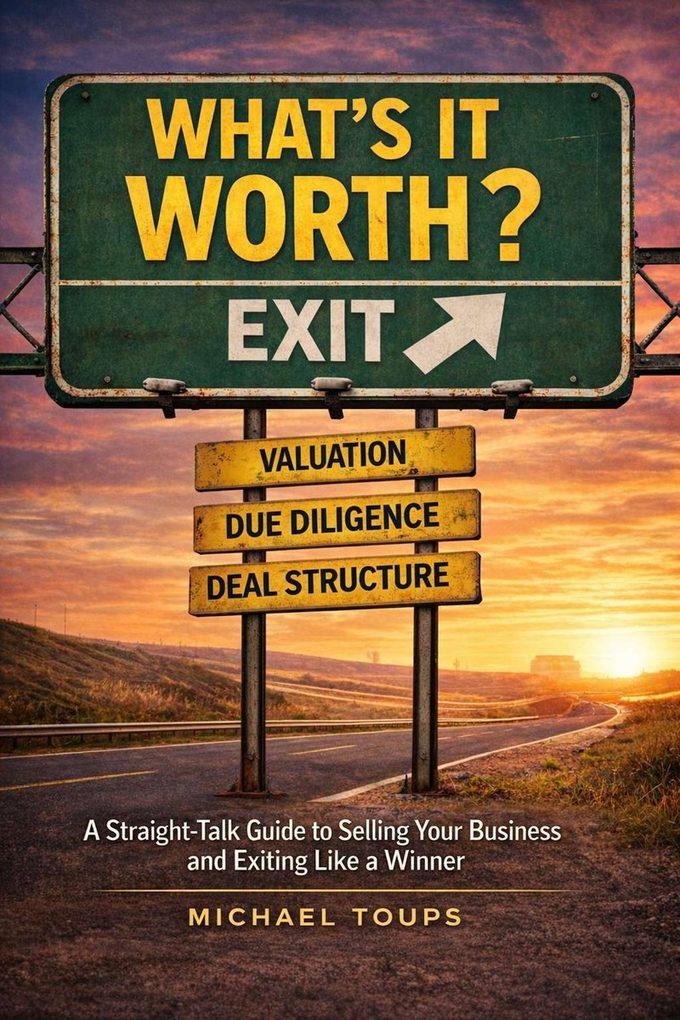
The question isn't just what your business is worth today. It's what it could be worth with the right preparation.Michael Toups · What's It Worth?
FAQ
Most privately held businesses are valued by multiplying normalized earnings by a market multiple. Owner-operated companies are usually priced on Seller's Discretionary Earnings (SDE), and larger companies with management in place are priced on EBITDA. The multiple is then adjusted for risk factors such as owner dependency, customer concentration, recurring revenue and the quality of the financial records.
It depends on size, industry, growth and risk. Many owner-operated Main Street businesses trade at roughly two to four times SDE, while larger companies are priced on EBITDA multiples that generally rise with size and quality of earnings. Crossfin gives you a range specific to your company rather than an industry average.
SDE adds the owner's salary and benefits back to profit, because a buyer of a small business usually replaces the owner. EBITDA assumes a paid management team is already in place, so it reflects the profit available to an investor rather than an owner-operator. Using the wrong measure can make a business look more or less valuable than it really is.
No. Crossfin provides a market-based valuation to help you plan and negotiate a sale. If you need a valuation for tax, estate, divorce, litigation or SBA lending purposes, you will need a credentialed appraiser, and Crossfin can help you coordinate with one.
Reduce how much the business depends on you, document your processes, clean up and normalize your financials, diversify your customer base and build recurring revenue. The earlier you start, ideally 12 to 24 months before a sale, the more of that value you capture.
Yes. Crossfin is based in Tampa, Florida and works with business owners nationwide. Most of the work can be done remotely.
Related Services
Build a business a buyer will pay a premium for.
Learn moreConfidential sale advisory from first call to closing.
Learn moreSeasoned counsel for owners and leadership teams.
Learn moreContact
Start with a 20-minute confidential call. We will talk through your business, your goals and what a valuation would show.
Tampa, Florida · Serving clients nationwide
Last updated November 2026 · Michael Toups, Crossfin